
Enterprise SSD Revenue Doubles to $37.6 Billion. The Bit Number Is Missing.
TrendForce puts top-five enterprise SSD revenue up 103.6% quarter over quarter. The mix shift underneath it is real — but smaller than the headline, and one of its drivers has nothing to do with AI.
Report parameters
Period: 2Q26 (calendar)
Published: Sep 1, 2026
Primary source: TrendForce press release
Coverage: Top five suppliers
Combined revenue: US$37.59B
Sequential change: +103.6% QoQ
Bit / ASP split: Not disclosed
Credibility: 8 / 10 · Importance: 9 / 10
Credibility reflects source type, not source quality: these are one research firm's supplier estimates, released publicly as a preview of paid data, with no vendor confirmation and no unit disclosure. Importance reflects the breadth of read-through across the NAND supply chain.
Combined enterprise SSD revenue at the five largest suppliers reached US$37.59 billion in the second quarter of 2026, up 103.6% sequentially, TrendForce reported on September 1. Samsung led with $14.35B, holding a 38.2% share. SK hynix Group, including Solidigm, took $8.63B. Micron grew fastest in the group, up 126.3% to $6.98B. Kioxia reached $4.64B and SanDisk $2.98B.
TrendForce attributes the increase to two forces moving together: higher NAND contract prices and stronger enterprise SSD shipment volumes, and expects demand to hold up in 3Q26 as cloud providers expand data-center capacity, generative AI agent services increase storage requirements, and NVIDIA GB-series deployments scale.
The rankings did not change. What changed is the shape of the curve and, underneath it, roughly two shared points.
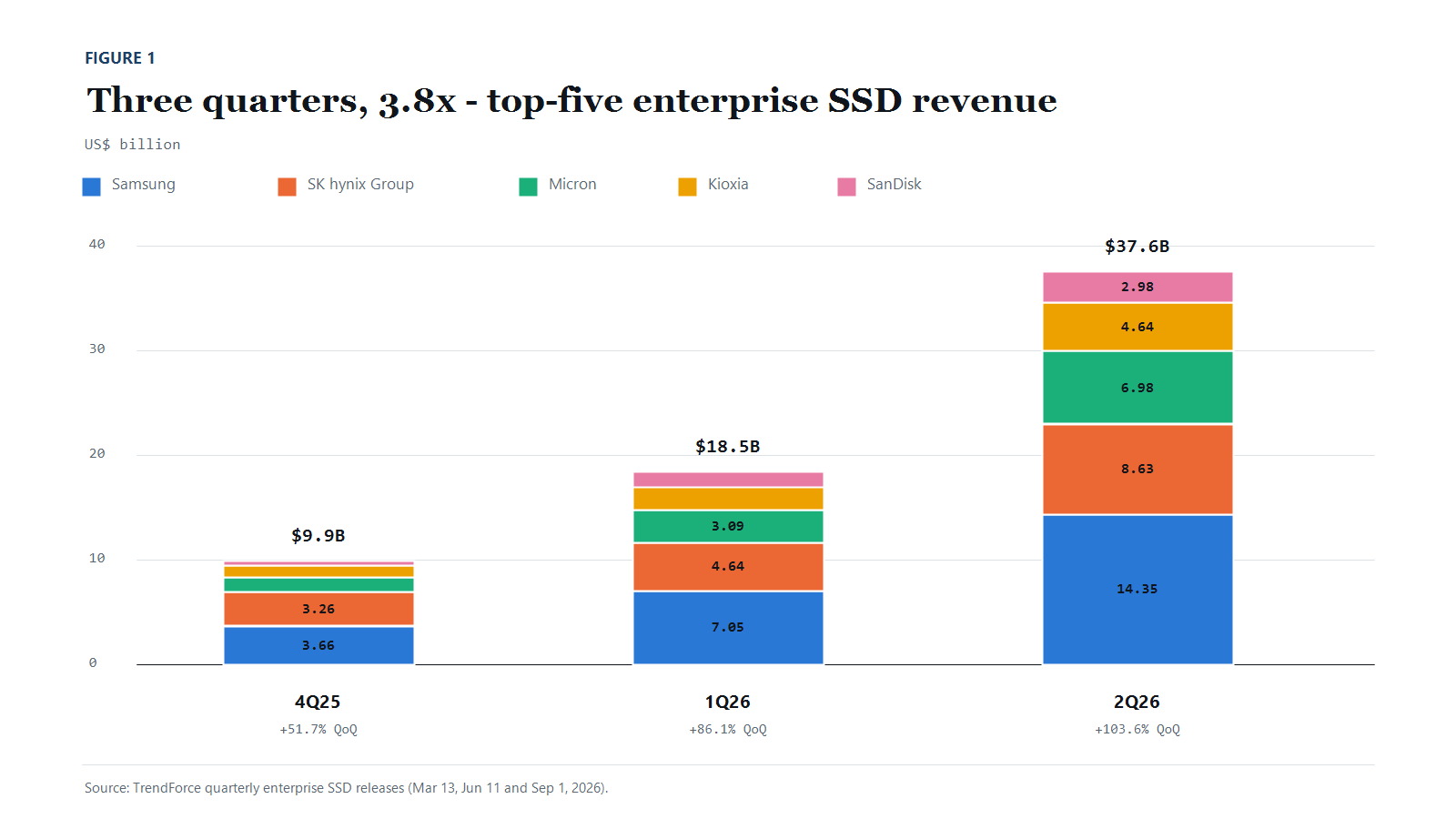
Figure 1. Three quarters, 3.8× — top-five enterprise SSD revenue. Source: TrendForce quarterly enterprise SSD releases (Mar 13, Jun 11 and Sep 1, 2026). Segment values in US$ billion; totals rounded.
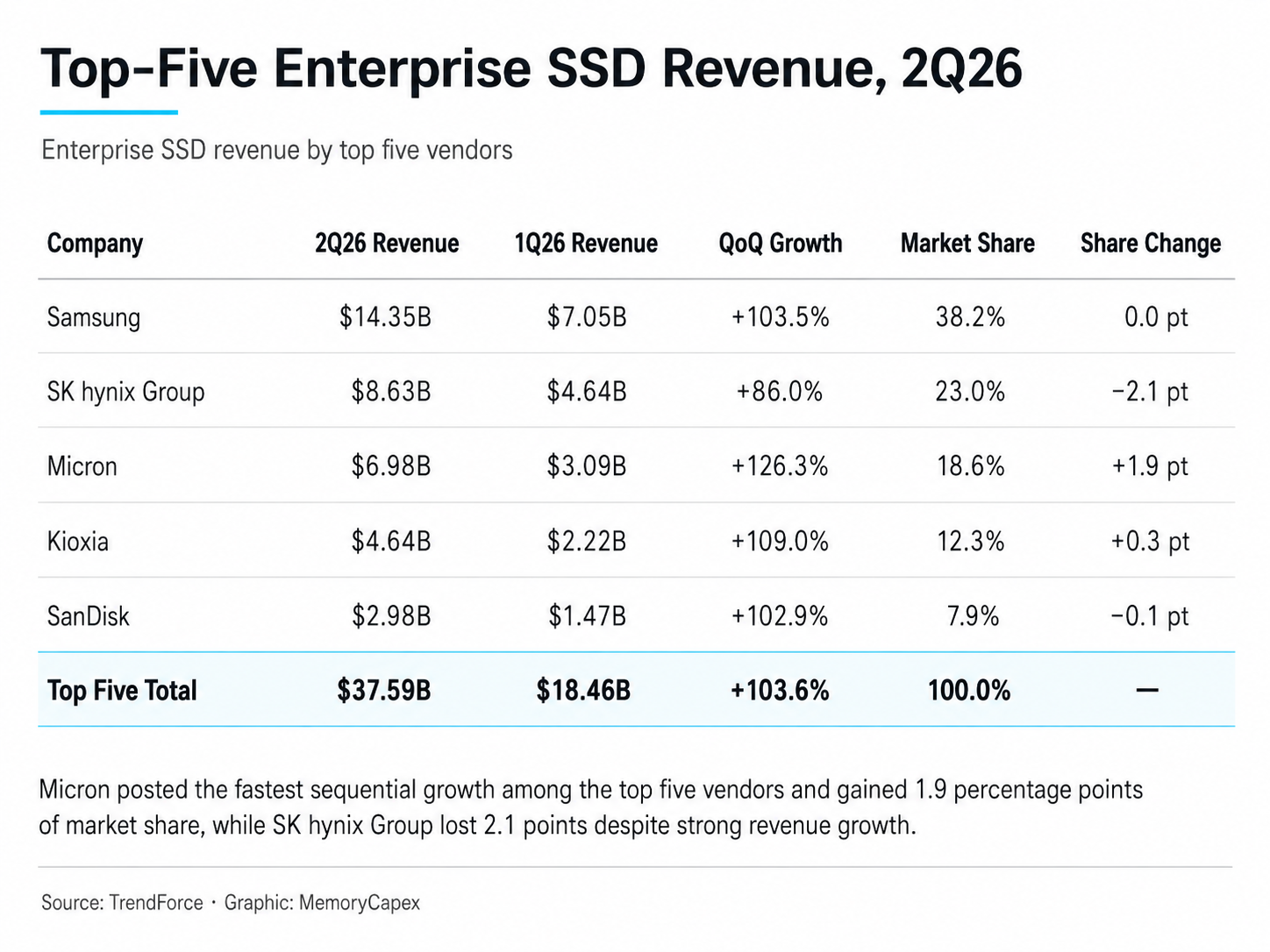
Revenue and QoQ per TrendForce. Share and Δ share are MemoryCapex calculations from the same figures.
What the release does not contain
TrendForce names higher contract prices and stronger shipment volumes without weighting them. Its own earlier release supplies the weights. In 1Q26, enterprise SSD contract prices rose roughly 80% amid historically low inventory — and SanDisk grew bit shipments about 20% in a quarter when its enterprise SSD revenue more than tripled.
Where the split is visible, the price-and-capacity mix did nearly all the work. A 103.6% revenue quarter is not evidence of a 103.6% demand quarter.
This is the single number that decides how the quarter should be read, and it is the one number nobody has published. Any thesis built on this release is provisional until enterprise bit growth is disclosed.
Measuring the broadening properly
The claim worth testing is that AI capital spending is reaching memory through a wider set of channels than HBM alone. There is a clean way to measure it. TrendForce's separate August 18 release put total NAND brand revenue at $68.87B in 2Q26, up 77%. Enterprise SSD accounted for 54.6% of all NAND brand revenue, up from 47.4% a quarter earlier — the first time the segment has cleared the half mark.
That 7.2-point mix shift, not the doubling, is the actual measure. The rest of NAND still grew 53% sequentially into visibly weak smartphone and PC demand, which is repricing rather than demand. The broadening is real. It is roughly a third the size the headline implies.
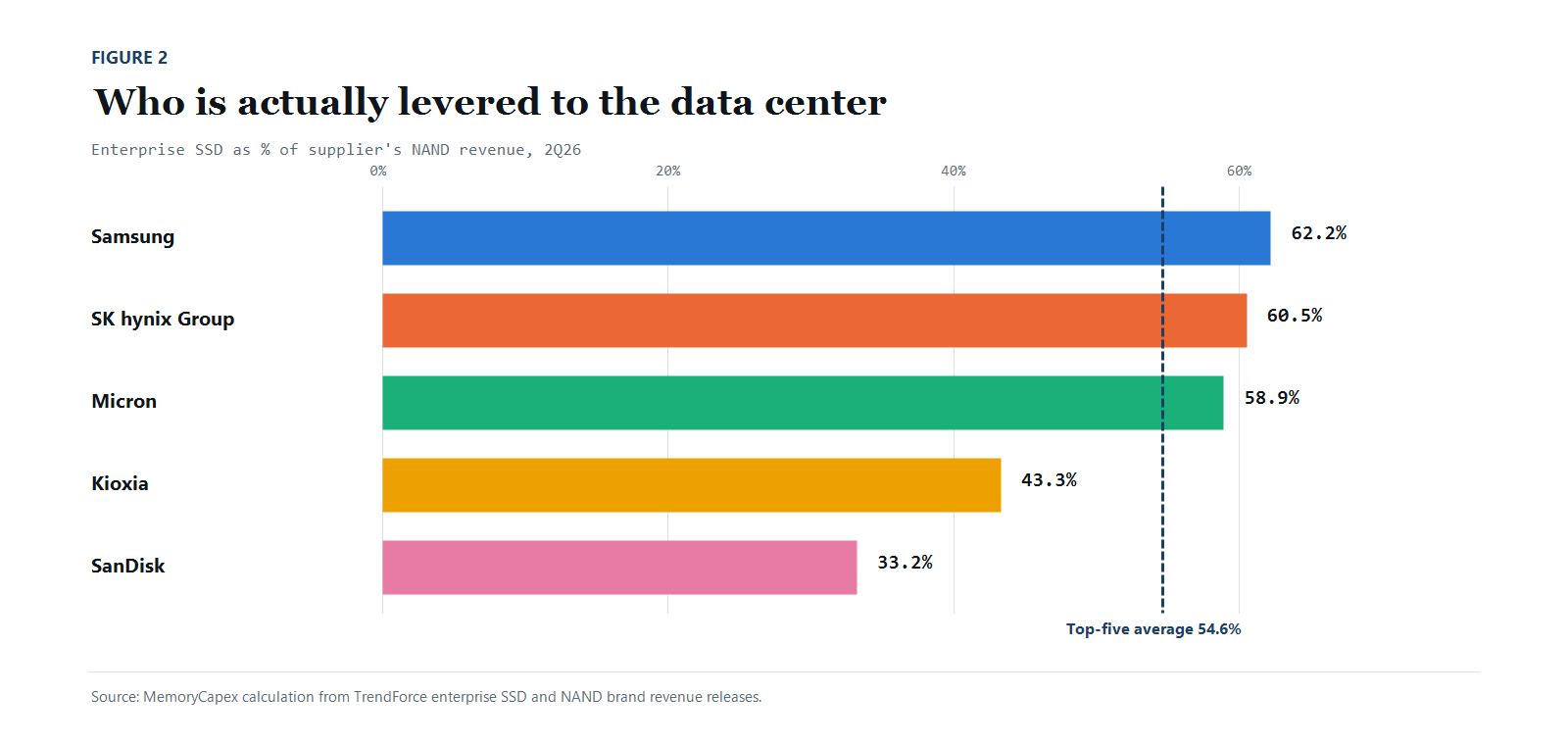
Figure 2. Enterprise SSD as a share of each supplier's NAND revenue, 2Q26. Source: MemoryCapex calculation from TrendForce enterprise SSD (Sep 1, 2026) and NAND brand revenue (Aug 18, 2026) releases.
Two drivers the headline hides
HDD substitution. TrendForce named nearline HDD supply constraints as one of three drivers of the enterprise SSD ramp in its 4Q25 report, alongside AI inference workloads and server refresh. That component is displaced demand, not new demand, and it unwinds when HDD supply normalizes. Attributing the entire ramp to AI capital spending is an attribution error that the release itself does not make.
Capex starvation. TrendForce's NAND release notes that capital expenditure prioritization toward DRAM and HBM is limiting new NAND capacity additions. This is the strongest argument for pricing durability in the whole data set, and it appears in neither the enterprise SSD headline nor in most coverage of it. Incumbents are not short of intent to add NAND capacity; they are short of capex that HBM has first claim on.
The share story is Micron versus SK hynix
Samsung's share was unchanged to a tenth of a point at 38.2%. The only material movement in the quarter was roughly 2 points transferring from SK Hynix Group to Micron. SK hynix grew 86.0% — the slowest in the group — despite Solidigm's position in ultra-high-capacity QLC, the exact product category TrendForce credits for the segment's growth. That tension deserves an explanation before anyone treats Solidigm as the franchise asset in high-capacity enterprise QLC.
Micron's technology commentary aligns with its own disclosure: in results for the quarter ended May 28, the company confirmed that its G9-based PCIe Gen6 SSD had entered high-volume production and that shipments of its 245TB QLC SSD had begun. These are two different products — the Gen6 drive is TLC, the 245TB drive is QLC on Gen5 — and neither carried meaningful revenue in the calendar quarter TrendForce is measuring. There are 2027 revenue events being confirmed early.
The risk is not only in China
TrendForce warns that rising output from Chinese suppliers and growth in China's domestic cloud market could reshape the competitive landscape. Two additions belong beside it. The growth rate — +51.7%, +86.1%, +103.6% — accelerates every quarter, a signature of a price shock; adoption curves decelerate. And Samsung's cited growth driver is QLC on a 176-layer node, a fully depreciated generation. Excellent for gross margin today, and a reminder that the supply response here is cheaper to mount than a shortage narrative implies.
MemoryCapex Take
The signal is the mix, not the multiple
Enterprise SSD crossed half of all NAND brand revenue for the first time this quarter. That is the finding worth keeping: the transmission of AI capital spending into memory is broadening beyond HBM and server DRAM into storage, and it is now measurable as a mix rather than inferred from a growth rate.
We would not yet call the quarter structural. Two of the four forces behind it — the contract-price reset and HDD substitution — are cyclical, and a third, the PCIe 4.0-to-5.0 transition, is a one-time step rather than a recurring rate. Only the fourth, capex starved by HBM, argues for durability, and it is a choice suppliers can reverse when relative prices move.
The defensible claim is narrower than the headline: enterprise SSD is taking a durably larger share of NAND revenue, on pricing that is not yet proven durable. On positioning, Micron is the cleanest read-through — it took share, and 59% of its NAND revenue now sits in enterprise SSDs. Kioxia at 43% and SanDisk at 33% remain levered to the consumer cycle, which the market has decided no longer matters.
Falsification test: If enterprise SSD bit shipments grow by less than roughly 25% in 3Q26 while revenue stays near current levels, this is a price cycle wearing an AI costume — and normalized quarterly revenue sits far below $37.6B. We will revisit this piece against that number when it is published.
Sources. TrendForce, “Higher Prices and Shipments Drive Top Five Enterprise SSD Vendors’ Revenue to Nearly US$37.59 Billion in 2Q26,” September 1, 2026; TrendForce NAND Flash brand revenue release, August 18, 2026; TrendForce enterprise SSD releases, June 11, 2026, and March 13, 2026; Micron Technology fiscal Q3 2026 results, June 24, 2026
#EnterpriseSSD #NAND #QLC #AIInfrastructure #Micron #Samsung #SKHynix #Kioxia #SanDisk