TECHNOLOGY → ECONOMICS → CYCLE → VALUATION
Technology.
Cycles.
Implications.
Investment intelligence for people who need to understand not only what changed in memory and storage—but when it matters, who it affects, and what the market has already priced in.
Illustrative private-beta indicators. Direction matters more than the absolute score.
Less news.
More accumulated knowledge.
We publish only when new information changes our view of supply, demand, technology, competitive position or valuation.
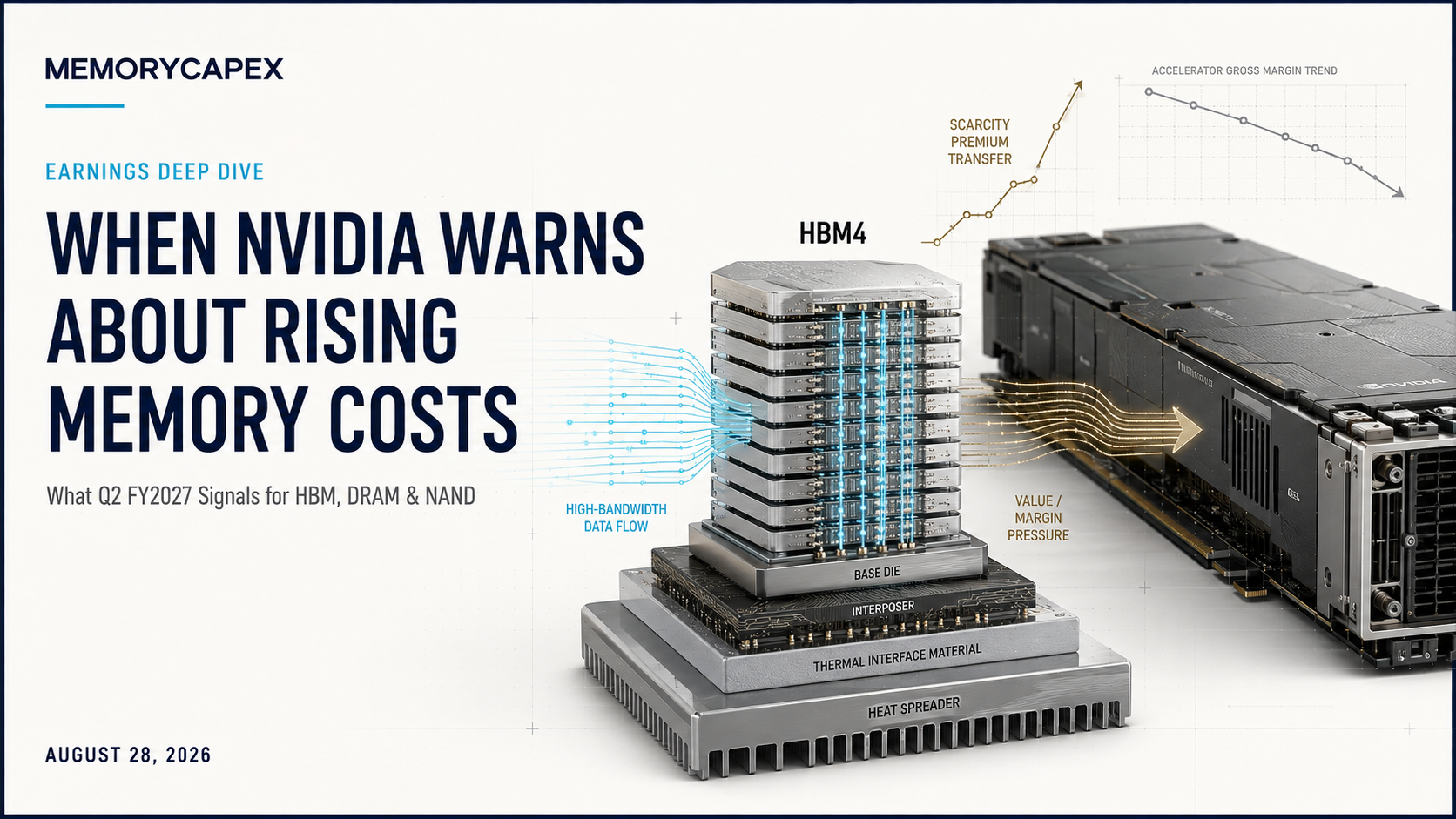
When record earnings stop moving memory stocks
The three places to look when fundamentals remain exceptional but equity returns begin to diverge: expectations, supply response and valuation.
HBM4 is not simply faster memory
Yield, advanced packaging and the HBM-to-DRAM trade ratio may reshape producer economics well beyond the AI accelerator market.
The strongest case against the memory upcycle
A disciplined review of China capacity, capex acceleration, AI concentration and the path from shortage to oversupply.
Five systems.
One investment view.
A research architecture designed to compound knowledge—not a content machine optimized for daily volume.
Memory Cycle Intelligence
A continuously updated view of pricing, inventory, utilization, bit growth, capex and demand—summarized in a directional cycle score.
Company Intelligence
Living research files that track roadmaps, capacity, costs, customers, guidance history, valuation and what changed since last quarter.
Technology Intelligence
HBM, advanced NAND, HAMR, CXL and AI storage translated into economics, competitive position and investable consequences.
Competitive Intelligence
Yield, node, cost, qualification, product mix and pricing power—not market share alone.
Investment Intelligence
Business quality, cycle position, earnings trajectory, expectations, valuation, catalysts, downside and thesis breakers.
Core coverage.
System-wide context.
Seven core companies sit at the center. The research boundary extends wherever supply, demand or technology can change their economics.
DRAM · HBM · NAND · NOR
Micron · SK Hynix · Samsung · SanDisk · Kioxia
→Enterprise SSD · Nearline HDD · HAMR
Western Digital · Seagate · Solidigm · Phison
→The next cycle variable
CXMT · YMTC · domestic equipment ecosystem
→Capacity and bottlenecks
Lam · Applied · ASML · TEL · TSMC · ASE · Amkor
→AI infrastructure and end markets
NVIDIA · AMD · AWS · Google · Meta · Microsoft
→The moat is
the memory.
Every quarter becomes structured, comparable and searchable. After twenty quarters, the archive becomes a proprietary, investor-oriented record of the industry cycle.
View the forecast discipline ↘Micron Intelligence
Awaiting quarter close
Sequential direction
Shipment trend
Model under review
Cycle signal
Supply response
Every forecast
leaves a record.
We attach a date, probability and explicit bull/bear conditions to every major cycle call—then review what we got right, what we missed and why.
Conventional DRAM remains structurally constrained through H2 2027.
HBM conversion constrains conventional DRAM for longer than expected.
CXMT expansion combines with a material hyperscaler capex slowdown.
Interpretation
that compounds.
News is a raw input. Each meaningful development must update a model, a company file, a cycle score or a forecast. If it changes none of them, it probably does not deserve publication.
- 01Know the cyclePricing · Inventory · Capacity · Capex
- 02Estimate expectationsConsensus · Valuation · Positioning
- 03Adjust exposureConviction · Risk · Time horizon
Memory Capex
An independent research project founded by Majid Asli, focused on connecting memory and storage technology, industry cycles and investment decision-making. Built in English from day one for a global research archive.
Building the track record
before the paywall.
Initial research will focus on proof of expertise, methodology and a clean historical record. No subscriptions. No daily content quota. No investment recommendations.
Request beta access ↗