
When NVIDIA Warns About Rising Memory Costs
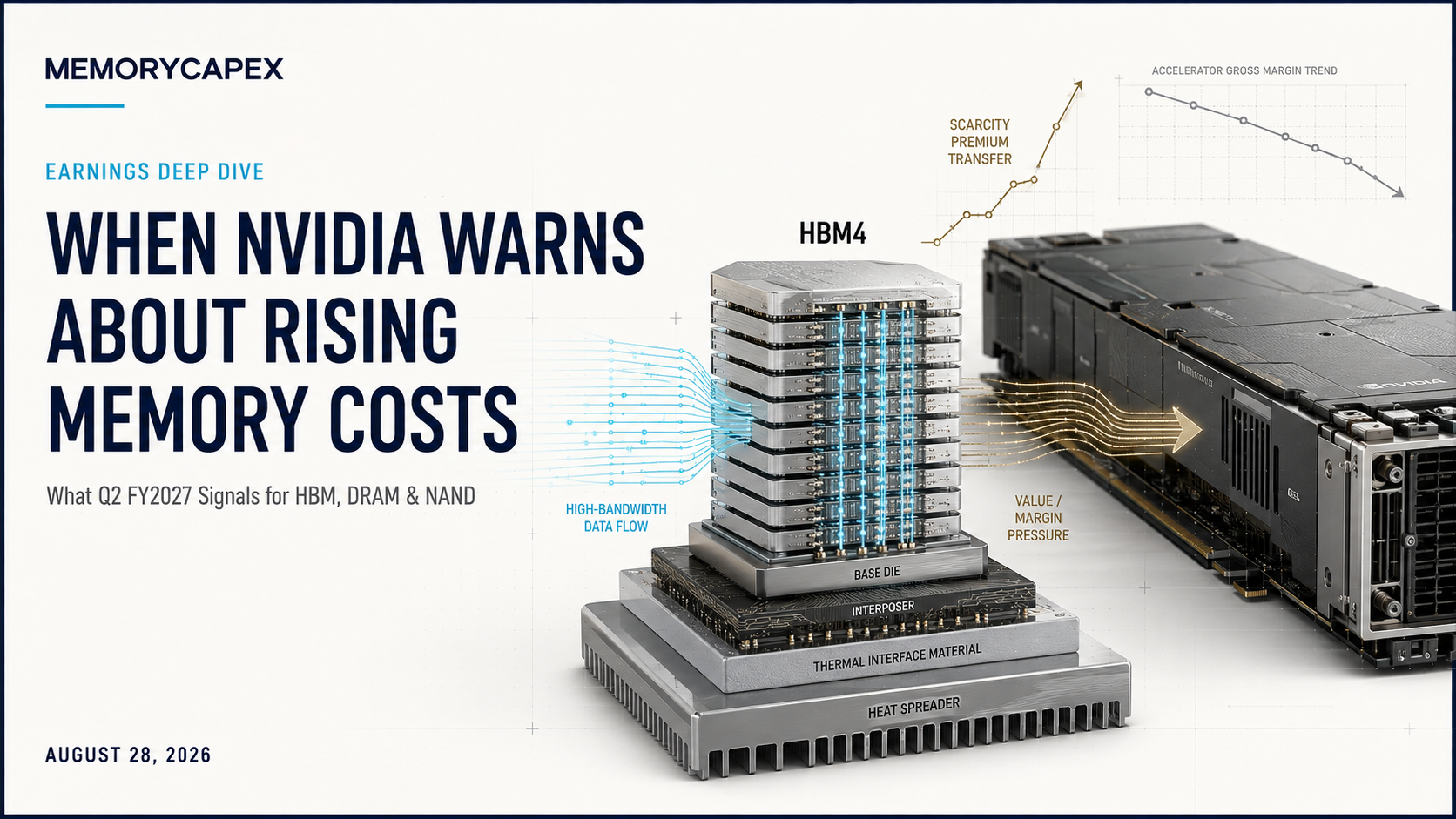
What NVIDIA's Q2 FY2027 earnings signal for HBM, DRAM, and NAND — and the assumptions an overly bullish read on memory suppliers would need to get right.
Executive Summary
NVIDIA's latest earnings report did more than confirm the strength of the AI infrastructure cycle. It may be the clearest independent evidence yet that memory has moved from a supporting component to a primary constraint on AI system deployment. The company with the strongest pricing power in the semiconductor value chain now says memory pricing conditions have become "severe," price increases have exceeded its prior assumptions, and costs are expected to rise further next year.
The more consequential signal appears on the balance sheet. NVIDIA's supply and capacity commitments increased from $119 billion to $279 billion in a single quarter. In its Form 10-Q, the company said these commitments are primarily to memory and manufacturing capacity that support current and future data-center architectures.
The near-term implication for memory suppliers is clear: pricing power has not yet peaked, and scarcity - at least within NVIDIA's planning assumptions, extends through the end of fiscal 2028. The investment conclusion, however, is less straightforward. Much of the favorable outlook may already be reflected in memory-stock valuations. The $279 billion figure is not equivalent to $279 billion in firm HBM orders, and the substantially higher efficiency of the Vera Rubin platform could eventually reduce memory consumption per token.
The central thesis of this report is:
NVIDIA's earnings extend the expected duration of the memory upcycle, but they do not eliminate the industry's cyclicality.
1. What the Earnings Report Actually Said
For the second quarter of fiscal 2027, ended July 26, 2026, NVIDIA reported revenue of $96.2 billion, up 18% sequentially and 106% year over year. Data Center revenue reached $89 billion, representing 92.5% of total revenue. Both GAAP and non-GAAP gross margins were 75%. For the third quarter, the company guided revenue of $108 billion, plus or minus 2%, and a gross margin of approximately 74%. NVIDIA earnings release
Those headline figures were exceptionally strong. For memory investors, however, three elements of the forward outlook matter more:
- NVIDIA expects fiscal 2028 revenue to grow by approximately 70%. That forecast is based on available supply, while management says unconstrained demand would be materially higher.
- The company expects supply to remain the bottleneck through at least the end of fiscal 2028.
- Higher memory costs are expected to reduce gross margin from 75% in Q2 to 74% in Q3, followed by a trough of 71%- 72% in Q4. After NVIDIA implements product price increases in Q1 FY2028, gross margin is expected to stabilize at 72%-73%. CFO commentary
That margin trajectory is important. NVIDIA is not forecasting a recovery based on lower memory prices. The expected improvement is driven primarily by higher product pricing. In other words, its FY2028 financial model assumes that elevated memory costs will persist rather than unwind quickly.
2. How Higher Memory Costs Affect NVIDIA's Economics
The full impact of higher memory prices was not yet visible in the reported quarter. Gross margin remained at 75%, roughly unchanged sequentially, as a richer Blackwell Ultra mix offset rising input costs. The pressure is expected to begin in Q3 and peak in Q4.
A Simple Gross-Margin Bridge
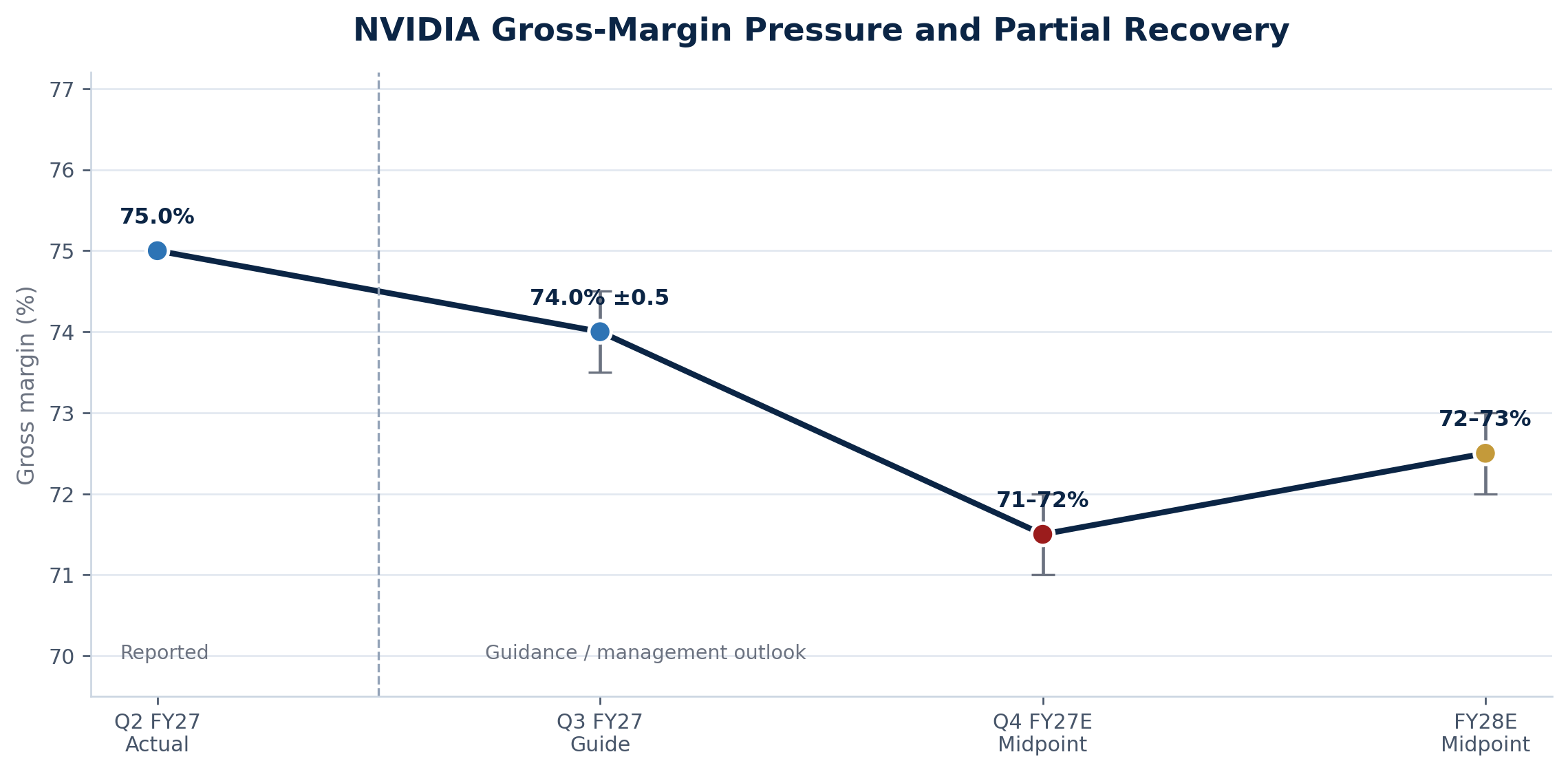
Source: NVIDIA Q2 FY2027 earnings release and management commentary. Range midpoints are shown for Q4 FY2027E and FY2028E.
Higher memory costs are therefore compressing margins, but they are not preventing substantial growth in gross-profit dollars. At $108 billion of quarterly revenue, each 100 basis points of gross margin is worth approximately $1.08 billion of quarterly gross profit.
If gross margin reaches the midpoint of NVIDIA's Q4 guidance - 71.5% - the decline from the current 75% would equal 350 basis points. That entire gap should not be attributed to memory. Product mix, yields, advanced packaging, tariffs, and inventory provisions may also contribute.
Even under a simplified scenario in which FY2028 revenue grows exactly 70% while gross margin falls from 75% to 72.5%, gross profit dollars would still increase by approximately 64%. Memory is capturing a larger share of system economics, but it is not yet undermining the economic power of NVIDIA's platform.
Why NVIDIA Is Not Passing Through the Full Cost Immediately
NVIDIA could raise prices more aggressively to defend margin, but an immediate and complete pass-through would create three risks:
- Lower customer returns and slower order growth;
- Stronger incentives for hyperscalers to accelerate internal ASIC development;
- A pricing shock in the middle of the Vera Rubin ramp.
The current strategy spreads the burden over time. NVIDIA is absorbing part of the pressure in Q3 and Q4, then implementing higher product prices from Q1 FY2028.
For memory suppliers, this is predominantly positive. A customer with NVIDIA's purchasing scale and bargaining power has accepted higher memory prices and adjusted its own pricing architecture accordingly. Yet the fact that FY2028 gross margin is expected to remain at 72%-73%, below the current 75%, also suggests that NVIDIA does not expect to fully offset the increase in input costs.
3. The $279 Billion Figure: The Strongest Signal - and the Easiest to Misread
NVIDIA's supply and capacity commitments increased from $119 billion at the end of Q1 to $279 billion at the end of Q2, a $160 billion increase in one quarter. The timing of those commitments is equally important:
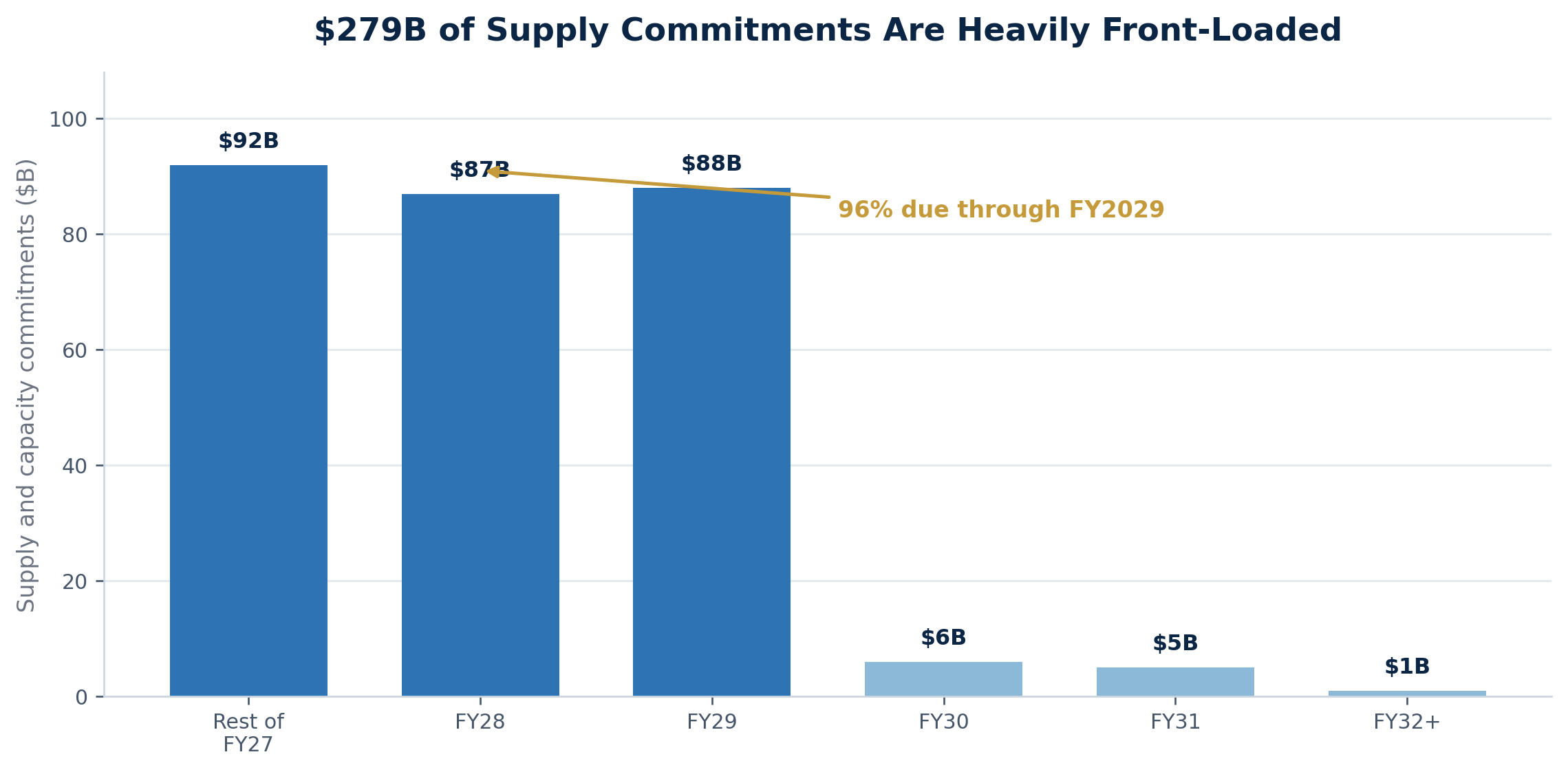
Source: NVIDIA Form 10-Q for the quarter ended July 26, 2026. Values may be cancellable, reschedulable, or adjustable.
Approximately $267 billion, or nearly 96% of the total, is concentrated through the end of FY2029. That materially improves demand visibility across the next three years.
Three common analytical errors should nevertheless be avoided.
First, $279 billion is not an HBM order book. The 10-Q states that the commitments primarily relate to memory and manufacturing facilities for data-center systems. NVIDIA does not disclose the allocation among HBM, LPDDR/SOCAMM, conventional DRAM, NAND, wafers, advanced packaging, and other manufacturing capacity.
Second, the $160 billion sequential increase cannot be translated directly into future revenue for Micron, SK hynix, and Samsung. Some contracts may cover manufacturing facilities or intermediaries elsewhere in the supply chain, and NVIDIA has not disclosed supplier-level allocations.
Third, the commitments do not all carry the same degree of enforceability. NVIDIA states that some agreements may be canceled, rescheduled, or adjusted to reflect business needs before firm purchase orders are issued. Such changes may incur costs, but the total should not be treated as a fully non-cancellable backlog.
Those qualifications do not weaken the directional signal. NVIDIA is sacrificing a significant degree of purchasing flexibility to secure multiyear access to memory and manufacturing capacity. Companies typically make that trade only when the perceived cost of scarcity exceeds the risk of overcommitting.
Inventory Supports the Same Interpretation
NVIDIA's inventory increased from $21.4 billion at the end of January to $31.6 billion at the end of July, a rise of approximately 48%. The composition is more informative than the total:
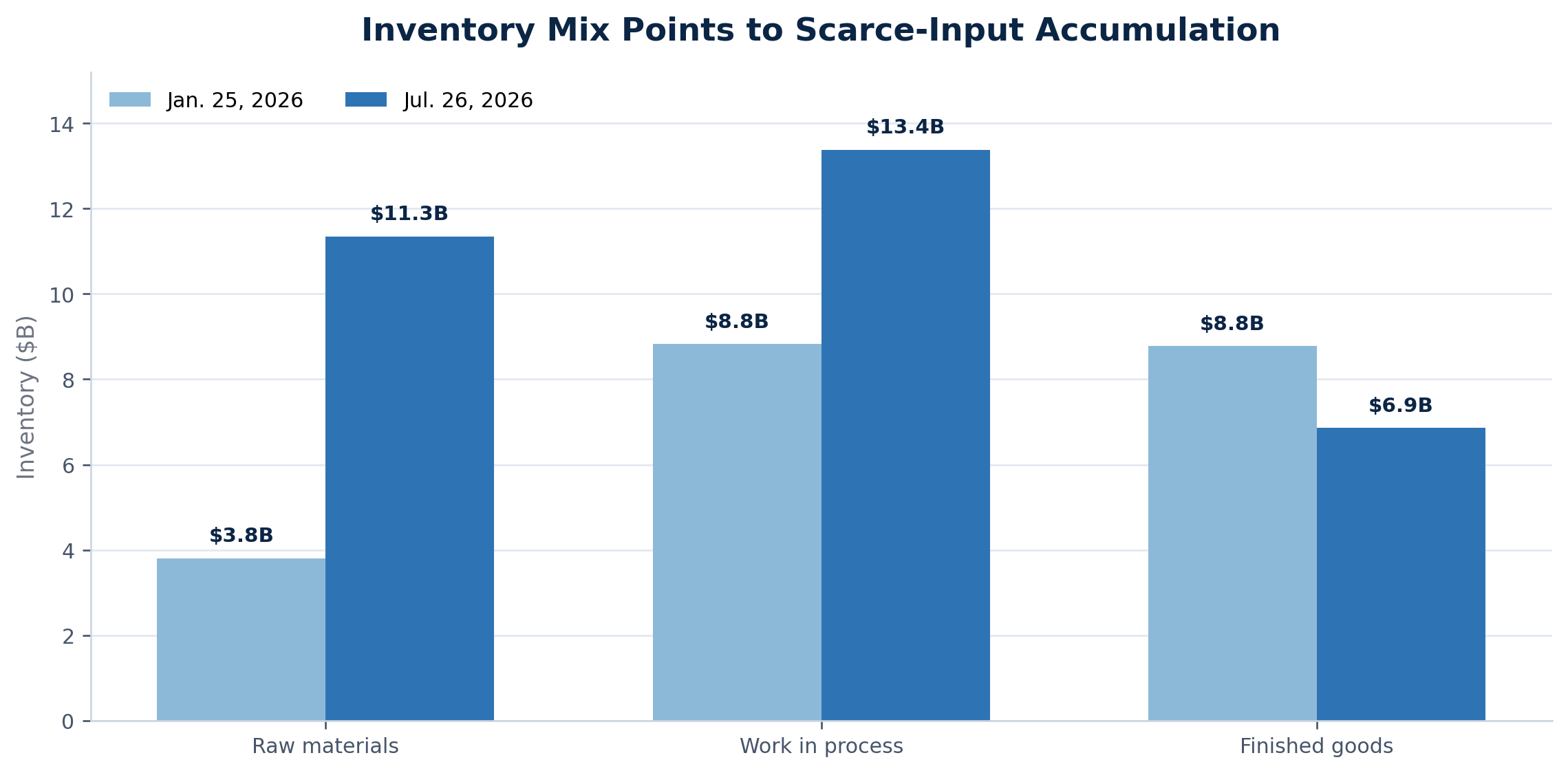
Source: NVIDIA Form 10-Q. Exact reported values are plotted; labels are rounded to one decimal place.
This mix is more consistent with a production ramp and the accumulation of scarce inputs than with weakening demand and excess finished goods. The decline in finished-goods inventory, alongside the surge in raw materials, supports the supply-constrained narrative.
That interpretation could reverse if finished goods begin to rise while revenue growth slows in subsequent quarters.
4. How Vera Rubin Changes Memory Economics
It is tempting to assume that each new GPU generation must dramatically increase HBM capacity per rack. NVIDIA's official specifications show a more nuanced picture.
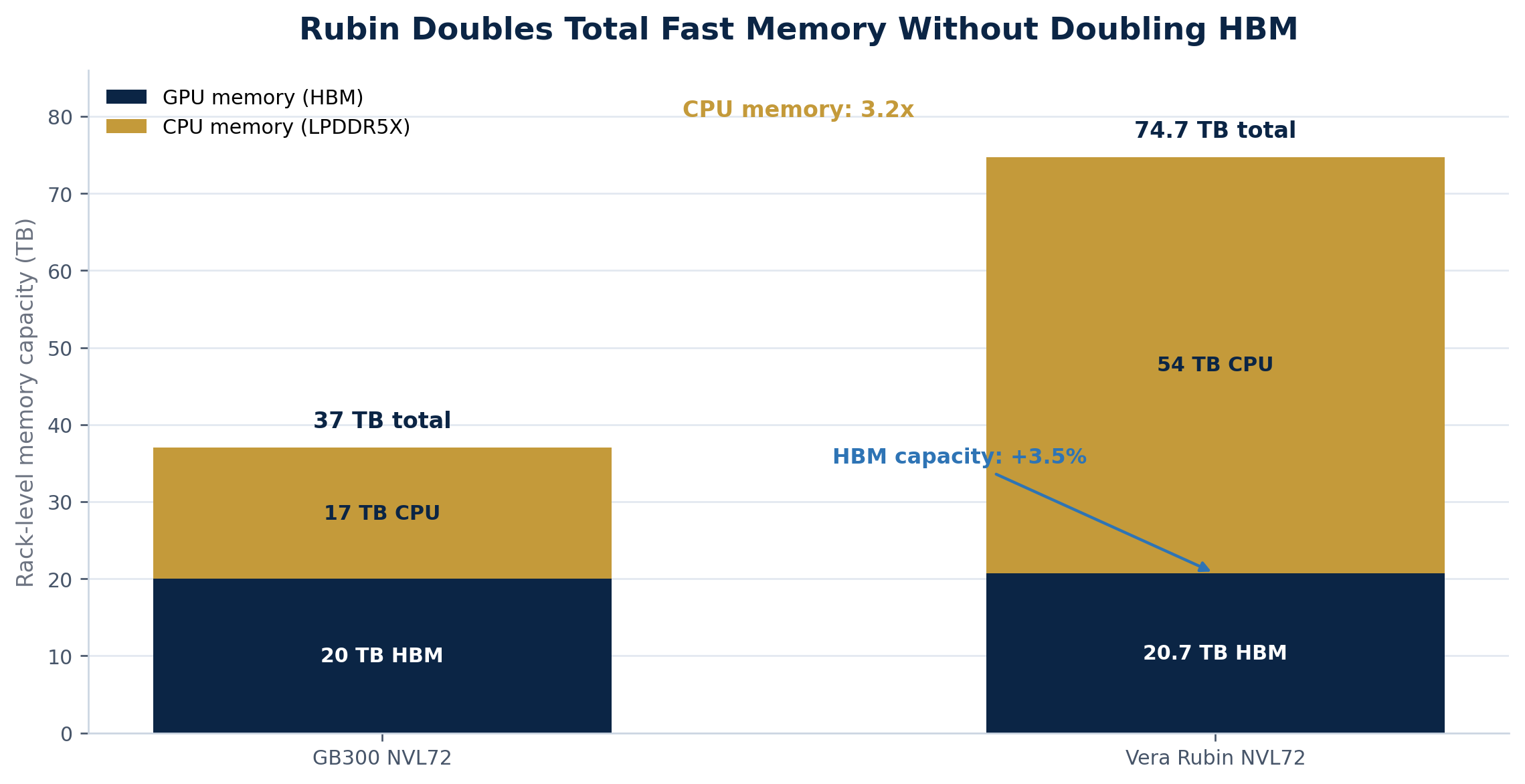
Source: NVIDIA official GB300 NVL72 and Vera Rubin NVL72 specifications. Total fast memory is GPU and CPU memory.
Sources: *GB300 NVL72 specifications* and *Vera Rubin NVL72 specifications*
What a Simplistic Bull Case Misses
HBM capacity per rack is broadly unchanged from GB300 to Rubin. The major advances are in bandwidth, the transition from HBM3E to HBM4, and the sharp increase in CPU memory. HBM revenue growth from Rubin must therefore come primarily from four sources:
- A larger installed base of racks and GPUs;
- Higher HBM4 pricing and value per bit;
- Greater manufacturing complexity in stacking, base dies, and advanced packaging;
- Growth in NVIDIA revenue per gigawatt - from approximately $25 billion for Blackwell to $40 billion for Rubin.
This distinction matters. An investment thesis built on the assumption that each Rubin rack contains substantially more HBM would rest on an incorrect technical premise.
The less obvious beneficiary may be CPU-side DRAM. CPU memory per rack rises from 17 TB to 54 TB. Micron has announced high-volume production of HBM4, SOCAMM2, and its sixth-generation SSD platform for Vera Rubin. SOCAMM2 can provide up to 2 TB of capacity and 1.2 TB/s of bandwidth per Vera CPU. Micron announcement
Higher Efficiency Is Both Bullish and Bearish
NVIDIA says Vera Rubin delivers up to 30 times more throughput per megawatt and a 35-fold reduction in cost per token relative to Grace Blackwell Ultra. For memory demand, those claims create two opposing effects:
- Jevons effect - the bullish case: Lower token costs trigger an explosion in inference demand, agentic workloads, and longer context windows. Aggregate consumption grows faster than efficiency improves.
- Efficiency effect - the bearish case: If demand is not sufficiently elastic, each workload requires fewer racks and less memory, causing bit demand to grow more slowly than compute performance.
Management is clearly underwriting the first outcome. The decisive evidence, however, must ultimately come from customer utilization and revenue - not NVIDIA's performance benchmarks.
5. Implications Across the Memory and Storage Value Chain
HBM4: Direct Impact, High Confidence
HBM is the most direct beneficiary. Rubin uses HBM4 at substantially higher bandwidth, while NVIDIA is securing memory supply on a multiyear basis. Yield constraints, stacking complexity, advanced packaging, and the logic base die mean that expanding supply requires more than adding wafer capacity. These barriers slow capacity growth and reinforce supplier pricing power.
SK hynix holds a particularly strong strategic position through its direct relationship with NVIDIA. The two companies announced a multiyear partnership in June covering the co-development of future memory generations and supply coordination with NVIDIA's roadmap. NVIDIA-SK hynix partnership
Micron's exposure extends beyond HBM. It is supplying HBM4, SOCAMM2, and PCIe Gen6 SSD products into the Rubin ecosystem, giving it a presence across GPU memory, host memory, and storage.
Samsung has entered HBM4 volume production and expects its 2026 HBM sales to more than triple. Its potential advantage lies in vertical integration across DRAM, logic base dies, foundry services, and packaging. NVIDIA, however, has not disclosed Rubin allocation among the three suppliers. Samsung HBM4 announcement
Server DRAM and SOCAMM: More Direct Upside Than the Market May Assume
Rubin's approximately 3.2-fold increase in CPU memory, combined with agentic inference and larger context windows, strengthens demand for LPDDR5X/SOCAMM and server DRAM. Allocating more wafers and equipment to HBM may also keep conventional DRAM supply constrained.
This spillover is visible in supplier results. SK hynix reported higher pricing in both DRAM and NAND in Q2 2026, the start of HBM4 volume shipments, and growth in SOCAMM2. Samsung said demand for HBM, server DRAM, and enterprise SSDs should accelerate in the second half, leaving the market undersupplied despite relative weakness in PCs and mobile devices. SK hynix Q2 2026 results and Samsung Q2 2026 results
NAND and Enterprise SSDs: Positive, but with Medium Confidence
Rubin is not solely an HBM story. BlueField-4 STX and inference context-memory architectures require high-capacity, high-performance storage. Micron's 9650 Gen6 SSD and Samsung's enterprise products are designed for this ecosystem. Growth in agentic AI, checkpointing, retrieval, vector databases, and KV-cache tiering should support enterprise SSD demand.
The analytical boundary is important: NVIDIA does not disclose how much NAND is included in the $279 billion of commitments. The earnings report therefore provides strong confirmation for HBM and DRAM, but only second-order support for NAND in terms of architecture and demand. Using the $279 billion figure to draw direct conclusions about SanDisk or Kioxia would be an overreach without additional data.
HDDs: Indirect Impact, Lower Confidence
The growth of AI factories and data volumes supports nearline HDD demand, but NVIDIA's margin pressure and memory commitments provide no direct evidence about HDD procurement. For Seagate and Western Digital, hyperscaler storage capital expenditure, exabyte shipments, and nearline pricing must be evaluated separately.
PC and Mobile Memory: The Risk of Demand Destruction
Higher pricing is not uniformly positive across every end market. NVIDIA's 10-Q says consumer PC sales are constrained by rising memory and system prices. As supply shifts toward HBM and server products, tighter PC and mobile memory supply may lift average selling prices - but beyond a certain point, it will also reduce unit demand. That is where pricing transitions from an earnings catalyst to a source of demand destruction.
6. The Bull Case for Memory After NVIDIA's Earnings
1. The Shortage Is Lasting Longer Than Expected
NVIDIA is securing supply not for one or two quarters, but through FY2029. Multiyear agreements improve suppliers' revenue visibility and the expected returns on fabrication and packaging investment.
2. The Value Chain's Strongest Customer Has Become a Relative Price Taker
When a company with a 75% gross margin must lower its margin outlook because of memory costs, supplier pricing power is real, not merely a narrative promoted by memory producers.
3. NVIDIA Can Pass Part of the Cost to Customers
Product price increases beginning in Q1 FY2028 should allow NVIDIA to recover part of the higher input cost. If hyperscalers and AI laboratories accept those increases, memory demand can remain strong without the full cost burden falling on unit volumes.
4. Rubin Expands Demand Across the Memory Hierarchy
HBM4, SOCAMM/LPDDR, server DRAM, and enterprise SSDs all play a role in the new platform. The approximately 3.2-fold increase in CPU memory is the most important data point often overlooked in an HBM-only narrative.
5. Supply Cannot Respond Quickly
HBM production depends on DRAM wafers, logic base dies, TSVs, stacking, advanced packaging, and yield. Fabrication capacity takes years to build, and packaging capacity must expand in parallel. This structure reduces the probability of an immediate supply glut.
6. Custom ASIC Growth Is Not Necessarily Bearish for Memory
TPUs, Trainium, and other custom accelerators may reduce NVIDIA's share, but many still require HBM and server memory. For memory suppliers, accelerator diversity can expand the customer base. The real threat would be architectures that require materially less HBM, lower-value memory, or less bandwidth per workload.
7. The Bear Case and the Thesis Breakers
1. The $279 Billion May Reflect Scarcity - but Also Sow the Seeds of Overbooking
Simultaneous capacity reservations by NVIDIA, hyperscalers, and ASIC developers increase the risk of double ordering. If supply arrives earlier than expected or AI capital spending slows, commitments may be rescheduled, and inventories could rise quickly.
2. NVIDIA Is Financing Part of Its Own Demand Ecosystem
The company is investing in AI laboratories, providing credit support to selected projects, and extending longer payment terms to some large customers. Accounts receivable increased from $38.5 billion to $63.1 billion in six months, while days sales outstanding rose to 60 days. If customer economics weaken, the risk is not limited to lower GPU orders: HBM, DRAM, and storage demand would be affected simultaneously.
3. NVIDIA's Price Increase Is an Elasticity Test
The projected FY2028 margin recovery depends on price increases beginning in Q1. If customers resist the new pricing, three outcomes become more likely: lower volumes, delayed deployments, or a faster shift toward custom silicon. All three are less favorable in terms of memory demand than the unconstrained-growth scenario.
4. HBM Capacity per Rubin Rack Is Not Increasing
HBM capacity is broadly unchanged from GB300 to Rubin. The bull case therefore, depends on higher system volumes, HBM4 pricing, and bandwidth value. If unit growth or average selling prices fall short, HBM revenue could lag NVIDIA's headline 70% growth rate.
5. A 30-Fold Efficiency Improvement Could Reduce Memory per Workload
If token demand grows more slowly than cost per token declines, fewer systems will be required for a given workload. The Jevons effect thesis is plausible, but it is not a law of nature. It must be confirmed through utilization and AI service revenue.
6. Today's Capital Expenditure Can Become Tomorrow's Oversupply
Micron, SK hynix, and Samsung are expanding fabs, cleanrooms, and advanced-packaging capacity. Much of that supply is due to arrive between 2027 and 2029, roughly when NVIDIA's current commitments are most concentrated. If the supply ramp coincides with slower demand growth, pricing power could reverse faster than expected.
7. Good Fundamental News May Not Be Good Investment News
Memory stocks had already re-rated on expectations of scarcity, HBM4 adoption, and higher pricing before this report. NVIDIA's results increase confidence in elevated earnings, but stock returns depend on the gap between realized outcomes and embedded expectations. If the market is already pricing a shortage through 2030, confirmation through FY2028 may not be enough to drive further upside.
8. Which Suppliers Have the Best Exposure?
NVIDIA's report is not sufficient on its own to select a stock, but the operating exposures can be separated as follows:
SK hynix
Primary advantage: Direct multiyear relationship with NVIDIA; strong position in HBM, HBM4, and SOCAMM2
Principal risk: Extremely high expectations, greater concentration in AI memory, and sensitivity to a cycle reversal
Micron
Primary advantage: HBM4, SOCAMM2, and Gen6 SSD exposure within Rubin; U.S.-listed memory pure play with exposure across the memory hierarchy
Principal risk: Smaller scale than Samsung, high capital requirements, cyclical volatility, and ramp-execution risk
Samsung Electronics
Primary advantage: Massive DRAM and NAND capacity, HBM4, and integration across foundry and packaging
Principal risk: Diluted exposure within a conglomerate and uneven execution across previous HBM generations
SanDisk / Kioxia
Primary advantage: Potential upside from enterprise SSDs, NAND tightness, and AI-storage growth
Principal risk: Less direct connection to NVIDIA's margin warning; NAND valuation and cyclicality
Seagate / Western Digital HDD
Primary advantage: Higher exabyte demand and expansion of AI data lakes
Principal risk: Weakest direct link to NVIDIA's memory commitments and continued dependence on nearline capital spending
In terms of signal purity, the report is most constructive for the HBM/DRAM group of SK hynix, Micron, and Samsung. For NAND and HDD suppliers, further confirmation is required from company-specific orders, pricing, and shipment data.
9. The Dashboard to Watch Over the Next Two Quarters
To determine whether NVIDIA's earnings mark a new phase of the memory supercycle - or a move closer to peak expectations - investors should monitor the following variables rather than focusing only on NVIDIA's headline revenue:
- NVIDIA gross margin: Whether the company delivers approximately 74% in Q3, troughs at 71%-72% in Q4, and stabilizes at 72%-73% in FY2028. A faster recovery without price increases could indicate easing memory costs.
- The Q1 FY2028 price increase: Customer acceptance, changes in order volume, and the response from custom-ASIC programs.
- Supply commitments: Whether the $279 billion total continues to rise, stabilizes, or declines - and whether the FY2028-FY2029 timing changes.
- NVIDIA's inventory mix: Raw materials and work in process versus finished goods. A sharp increase in finished goods would be a warning sign of demand.
- The Vera Rubin ramp: Its expected contribution of approximately 20% of Data Center revenue in Q3 and the anticipated reacceleration in hyperscale revenue in Q4.
- HBM4 yields and allocation: Actual supply shares for SK hynix, Micron, and Samsung - not merely qualification announcements or samples.
- Server DRAM and enterprise SSD pricing: Whether HBM tightness is genuinely spilling into conventional DRAM and NAND.
- Capital spending and capacity timing: SK hynix's M15X and Yongin projects; Micron's Idaho, New York, and Taiwan; and Samsung's capacity additions.
- AI customer economics: Utilization, token revenue, hyperscaler backlog, NVIDIA's DSO, and the need for credit support.
- Memory content by generation: HBM capacity, CPU memory, and storage requirements in Rubin Ultra and the architecture that follows.
Investment Conclusion
NVIDIA's Q2 FY2027 report provides some of the strongest evidence yet that the memory upcycle can extend through 2027 and potentially into 2028. Three data points support that conclusion: the increase in supply commitments from $119 billion to $279 billion, the explicit warning that memory prices will rise further next year, and NVIDIA's plan to recover part of the cost through higher product prices.
The more precise interpretation is not simply that what is negative for NVIDIA must be positive for memory suppliers. NVIDIA's margin is declining, but its gross-profit dollars are still growing rapidly. HBM capacity per Rubin rack is broadly unchanged, while bandwidth and CPU memory are increasing sharply. The commitments are enormous, but they are not all firm HBM purchase orders.
The report is therefore most bullish for HBM4 and server DRAM. It provides meaningful but lower-confidence support for enterprise SSDs and NAND, while the implication for HDDs remains primarily thematic.
The thesis remains intact as long as Vera Rubin ramps on schedule, customers accept NVIDIA's higher pricing, finished-goods inventory remains controlled, and new supplier capacity does not arrive faster than demand grows.
Bottom line: NVIDIA's earnings increased the probability of a longer memory shortage - not the probability that the memory cycle has disappeared.
Primary Sources
- <span style="font-size: 12px;">NVIDIA Q2 FY2027 Earnings Release</span>
- <span style="font-size: 12px;">NVIDIA Q2 FY2027 Form 10-Q</span>
- <span style="font-size: 12px;">NVIDIA Q2 FY2027 CFO Commentary</span>
- <span style="font-size: 12px;">NVIDIA Vera Rubin NVL72 Specifications</span>
- <span style="font-size: 12px;">NVIDIA GB300 NVL72 Specifications</span>
- <span style="font-size: 12px;">Micron Products for Vera Rubin</span>
- <span style="font-size: 12px;">NVIDIA-SK hynix Multiyear Partnership</span>
- <span style="font-size: 12px;">SK hynix Q2 2026 Results</span>
- <span style="font-size: 12px;">Samsung Q2 2026 Results</span>
#NVIDIA #HBM #HBM4 #DRAM #NAND #VeraRubin #MemoryPricing #AIInfrastructure